CME: Organisational Alignment & Operational Clarity
Overview
CME came to us with a hard problem: information was not flowing across subsidiaries and roles.
CME is Petrobras's international commercial and markets organisation. Spread across four offices, the team lived with friction, unclear responsibilities, and inconsistent practice. The brief was not to analyse the problem. It was to build alignment and real projects that would keep running across time zones long after we left.
Challenge
Communication broke down between operational and support roles, and information moved differently depending on who you asked. Responsibilities overlapped in some places and fell through the gaps in others, with no shared view of workflows or best practice.
Underneath the process problems sat two harder ones. The first was posture: "we always did it like this" had become an answer rather than a starting point. The second was distance. A team spread across countries and cultures read the same situation in different ways, and what looked like disagreement was often people describing different things in the same words. Before anything could be redesigned, the way people saw the problem had to shift.
The task was to design a smooth, real-time flow of information without adding complexity or bureaucracy. Leadership wanted alignment, and more than that, tangible outputs that could improve daily operations and scale globally.
Approach
The team did not need another analysis. They needed to see their own situation from the outside.
A high-level mapping of the organisation already existed, drawn from above, and it had been shelved. We went the other way and worked from the ground up, over a year, on human-centred design. Rather than fly in and run it ourselves, we trained CME’s internal lead to design and carry the sessions herself, so the work had an owner inside the business from the start.
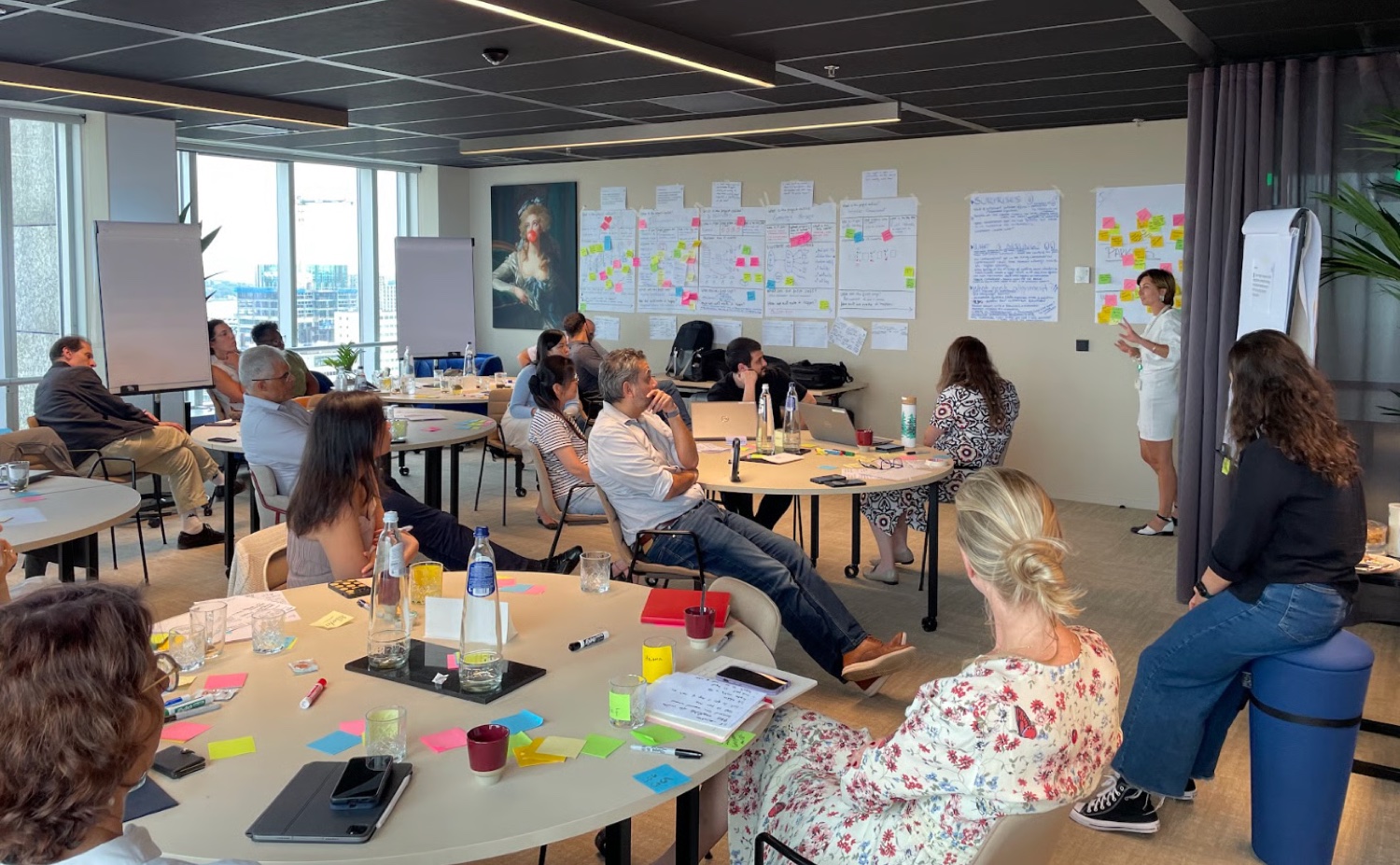
What came back was not a report. We visualised what we heard, categorised it, and translated it into something the team could stand in front of and point at: where the gaps sat, why they were there, and what they cost. People too close to the work to see its shape could finally see it whole. That view is what made a strategic conversation possible, and it is what turned three days in Rotterdam into decisions instead of discussion.
Equip the lead
We trained CME’s internal lead in human-centred facilitation, so the programme belonged to the business rather than to us.
Local rounds
She designed and ran the local rounds herself, office by office, with us coaching between sessions. Each site’s pain points surfaced in its own language and context.
Three days in Rotterdam
The whole group converged to align, simplify and act: roles and ownership, end-to-end workflows, then action planning with named owners.
Follow-through
Coaching and a governance rhythm across the months that followed, so what was decided in Rotterdam survived contact with daily work.
Methods we ran
Outcome
- Five global improvement projects designed and assigned to cross-functional teams, with clear ownership and next steps. Three have since been delivered and two are still running.
- Three quick wins implemented on the spot, solving long-standing friction without waiting for the wider projects.
- Salesforce adoption from 0% to 80% across the team, turning a system people worked around into the one they work in.
- Clarity on roles, workflows and responsibilities that gave people confidence and renewed motivation.
- A programme built to hold, praised for turning complexity into action rather than another report.
The project marked a shift in how CME approaches operational challenges: more ownership, better collaboration, and a stronger commitment to human-centred problem solving.
What’s next
The habit matters more than the projects.
What we are embedding now is the capacity to keep going without us: tools and rhythms that keep the team questioning how things are done, simplifying what has grown complicated, and staying aligned as the organisation changes around them. That work continues under Make It Clear, the next stage of the partnership.